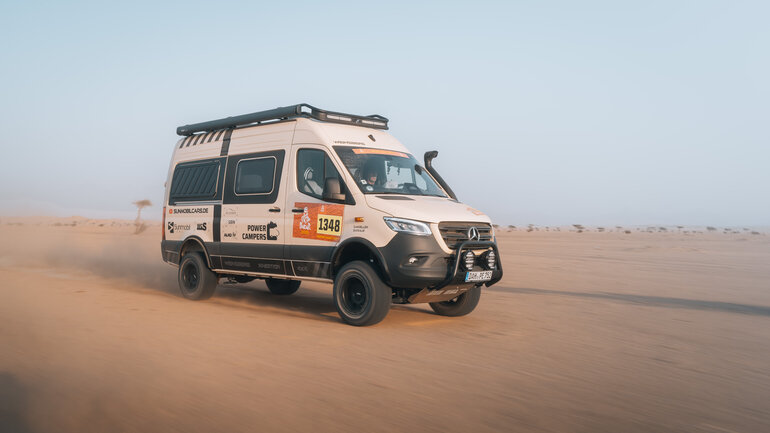
Earlier this year, a WEINSBERG X-PEDITION campervan, based on a Mercedes Sprinter, took part in the Dakar Classic 2026 in Saudi Arabia, as a fully operational service vehicle tackling gravel, sand, rocks and punishing desert heat for over two weeks.
The test raises an interesting question: what does extreme rally use tell us about modern motorhome durability?
Built for more than campsites
The X-PEDITION ran in a near-production off-road configuration, complete with raised suspension, reinforced rims, additional lighting and an off-road levelling system. Over 18 days of sustained use, it reportedly completed the event without breakdowns.
For UK tourers, that level of resilience matters. Rural campsites, uneven pitch site fields, coastal tracks and Scottish single-track roads can all test suspension and chassis strength, especially on heavier vehicles.
Off-grid independence under pressure
Perhaps more relevant to everyday touring was the vehicle’s self-sufficiency setup. Equipped with lithium batteries, solar panels, charge boosters and inverters, the motorhome functioned as a fully operational “mobile office” throughout the rally.
That kind of off-grid capability mirrors a growing trend in UK touring, where more owners are seeking longer stays away from hook-up pitches.
Reliable 230V supply, strong battery storage and efficient charging systems are becoming less of a luxury and more of an expectation.
What it means for tourers
Motorsport has long been used as a proving ground for automotive development and projects like this suggest rugged, adventure-ready motorhomes are becoming more mainstream.
While most owners won’t face desert dunes, the reassurance that a vehicle platform has been tested under extreme stress offers confidence closer to home, whether that’s winter touring in the highlands or navigating muddy festival fields.
If a motorhome can survive Dakar conditions, a windswept British coastline may feel positively gentle by comparison.
Image: Knaus Tabbert