
Most romantic honeymoon road trips revealed

Road trips make a great honeymoon option, especially if you have access to a caravan or motorhome, but where to explore on your post-wedding holiday can be a hotly contested topic between couples.

New research from Confused.com has revealed that the German Alpine Road, which stretches for 326 miles, is the most romantic route to take.

With a romance score of 9.56 out of ten, the German itinerary takes lovers past the Linderhof Palace and the fairytale Neuschwanstein Castle.

Coming in second place was Puglia in Italy, which received a score of 9.13, but came up short in terms of length at just 112 miles.

Two other Italian road trips were featured on the list, with the Amalfi Coast and Tuscany both featuring in the top five.

At just 38 miles, the former can be explored in a single day, while 193 miles of roads through the Tuscan hills could be enjoyed at leisure in your caravan or motorhome.

Closer to home, Scotland’s North Coast 500 made the list at number four and Ireland’s Wild Atlantic Way was voted in sixth position.

Other slightly less expected road trip destinations that secured a place in the top ten included Icefields Parkway in Canada and Norway’s Lofoten.

Aptly named Romantic Road in Germany came in at number ten, although by rights it probably should have bagged a higher spot.

Alex Kindred, car insurance expert at Confused.com, said: “Taking a road trip, at home or abroad, can make for an unforgettable experience.

“And if you’re travelling along some of the most romantic or idyllic routes the world has to offer, take turns behind the wheel. This offers you both the chance to enjoy the scenery while avoiding tiredness.”

Long distance driving routes are becoming more popular, with everywhere from Iceland’s Ring Road to Mexico’s Yucatan Peninsula attracting newlyweds.
The cheapest pitching spots around the UK

Planning a summer getaway but don’t want to break the bank? 

There are few spots across the UK where you can enjoy wild camping without spending a penny, while most places require a nightly fee to put your tent up or park your vehicle and use their facilities. 

The experts at Pitchup have you covered with their latest report identifying the cheapest spots in the UK to camp, glamp, tour or caravan at as the weather improves. 

Over 60 per cent of Brits are looking forward to travelling again after years of lockdowns and restrictions due to the pandemic. 

People are also more inclined to travel locally and reconnect with nature on their home ground rather than go overseas. 

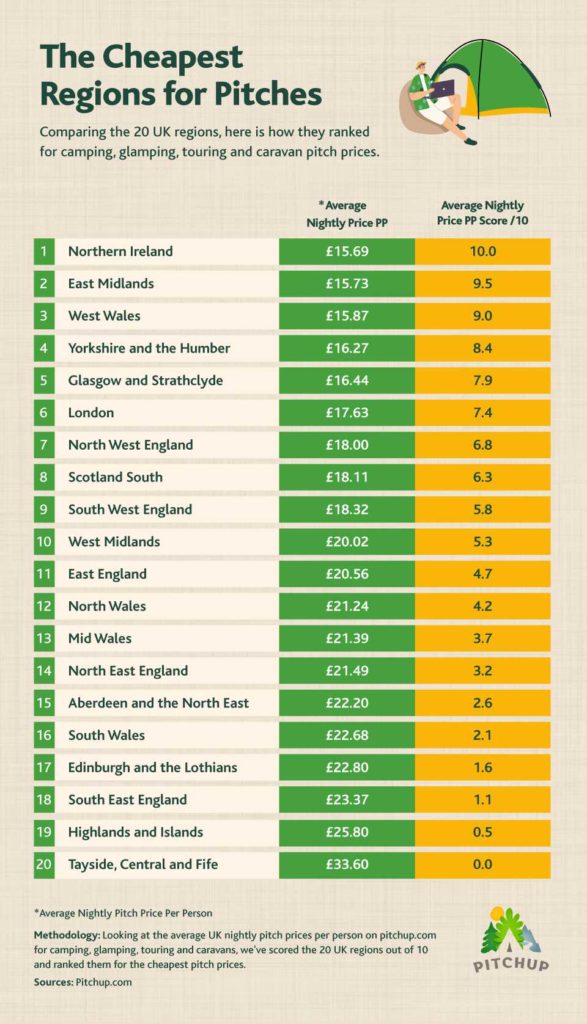
The report compared average nightly prices for camping, glamping, touring, and caravan pitch prices in 20 regions throughout the UK. Some of the results might surprise you.

According to their findings, the cheapest spot to pitch up was Northern Ireland, with an average price per night of £15.69. 

If you’re looking for an affordable destination to take the family during the summer holidays – Northern Ireland’s rugged coastline and rolling, green countryside could be the perfect getaway location. 

Plus, at 23 per cent cheaper than the average price per night across the UK – it’s a bargain!

Coming in second place is the East Midlands, which costs, on average,  £15.73 per person per night. Home to numerous spots to pitch up your leisure vehicle or tent, there’s plenty on offer in this verdant region including the cities of Nottingham, Leicester and Lincoln. 

Other affordable locations on the list include West Wales and Yorkshire and the Humber, which cost 15.87 and £16.27 respectively. 

Although most of the destinations surveyed in the study were some of the UK’s top holiday destinations, the majority of locations cost, on average, less than £20 per night per person. 

So if you’re looking for a bargain holiday in the glorious outdoors, why not take advantage of the breathtaking and affordable British countryside that’s right on your doorstep? 

Take a look at the results of the full study in the infographic below and start thinking about which part of the UK you’d like to explore next.


cheapest pitching sites UK


Photo credit: Mac DeStroir/Unsplash 

DVSA launches new trailer accreditation scheme

The Driver and Vehicle Standards Agency (DVSA) has launched a new scheme to help anyone who tows stay safe on the roads.

Aimed at both first-time towers and those who use trailers regularly, the new accreditation will be relevant for anyone who owns or rents a touring caravan.

From today (May 18th), drivers with plans to tow a caravan are urged to take a training course before their next trip.

Mark Winn, chief driving examiner at the DVSA, said: “With the summer holidays fast approaching, we know many families will be looking to tow a trailer or caravan so it’s vital you have the skills to do this safely.”

Trainers have been accredited under the new scheme in the last few months and are offering a selection of options for motorists to sign up to:

  • Towing for beginners
  • Returning to towing after a break
  • Towing larger trailers
  • Refreshing and formalising the skills of regular towers

All of the courses will follow the learning to drive a car and trailer syllabus, which has been developed by the DVSA with experts in the industry.

When seeking an accredited trainer, choose one that specialises in caravan towing and ask for a price upfront, as the course leaders will be setting their own prices.

To find a course, you can email the Safe Towing Scheme at info@safetowingscheme.co.uk.

Baroness Vere, minister for roads, buses and places, said: “Towing safely is an important issue and I urge drivers to access the training to help keep Britain’s roads safe.”

Towing a caravan incorrectly can lead to fines of up to £1,000, so make sure you’re up to speed on safety rules and best practices.


Photo credit: Pexels/JESHOOTS

Travelworld celebrates 10 years of Hymer franchise

The Erwin Hymer Centre Travelworld is celebrating a decade of being an official franchise of Hymer motorhomes.

To mark the occasion, it caught up with Alan and Gillian Cunnington, who were the first customers to purchase a vehicle from the dealership after it was accredited ten years ago.

Mr and Mrs Cunnington selected a luxury Hymer Exsis-i 674 to drive off the forecourt back in 2012 and have been creating memories in it ever since.

In fact, they’ve been so pleased with their purchase that they’ve opted to upgrade it over the years as opposed to trading it in for a newer model.

Mr Cunnigton said: “We had hired motorhomes in the past while in New Zealand and Canada and decided to take the leap and buy one.

“We looked at dozens at various shows before we went to Travelworld and met Ross Edwards [the managing director].

“We saw the Exsis-i and it was the exact spec we wanted and could be replated to 3500kg. The next day we bought it.”

Since then, the Cunningtons have toured all over the UK and parts of Spain in their beloved motorhome.

When they’ve looked at newer leisure vehicles, the couple have decided they don’t compare favourably to what they’ve already got.

So, when visiting a show and seeing an updated kitchen that suited their needs, they decided to have it fitted in their trusty Hymer instead of replacing the entire vehicle.

The Cunningtons have updated the motorhome’s technology features too, with 5G Wi-Fi, a reverse camera and an Oyster satellite system all fitted in the intervening years by Travelworld.

Now that travelling is opening up again in the wake of the pandemic, Mr and Mrs Cunnington are looking forward to holidays away in their motorhome, with members of the family joining in the fun in their own leisure vehicles.

Hymer credits itself as the inventor of the motorhome and has been producing such vehicles since 1957. Travelworld has the largest number of Hymer models on display in the UK.

Wild camping laws across Europe

With 62 per cent of Brits feeling confident about traveling again after the pandemic, it’s time to start planning your next camping adventure. 

You might not be aware, but there are lots of rules and regulations about wild camping around Europe. 

It’s not legal to simply find a spot and pitch your tent in many places, and doing so can result in hefty fines that’ll put a damper on your holiday.

What’s more, many people don’t realise that wild camping usually refers to arriving on foot, so doesn’t tend to be compatible with caravans, motorhomes and campervans.

When you don’t incur a huge fee at the end, wild camping can be an incredibly liberating and memorable experience. 

Making sure you do it safely and legally will ensure your holiday isn’t ruined before it even begins.

Here’s what the law has to say about wild camping in some key European holiday destinations, as explained by the experts at Pitchup.

United Kingdom

As travel resumes, 70 per cent of Brits agree they’d prefer to take regular UK breaks over an annual overseas holiday. For any avid campers out there, it’s important to know the UK’s stance on wild camping. 

In England and Wales, wild camping is only legal with the land owner’s permission. Dartmoor National Park is one exception where the activity is permitted, but there are still restrictions in place as to where. However, there are plenty of nearly wild campsites to pitch up at. 

Further north in Scotland, right-to-roam laws are still in place. This means it’s legal to set up camp as long as you follow the Scottish Outdoor Access Code

Italy

Free camping is not legal in Italy. You could face a fine of €100 (£85) to €500 if someone catches you. 

The local authorities regularly patrol key tourist areas, particularly along the coast, to enforce this rule. 

If you do want to camp in Italy, you’ll need to stay in a campsite, of which there are plenty. Checking out the listings of Italian sites on the Caravan and Motorhome Club’s website is a good place to start.

France

In France, wild camping is generally well-tolerated as long as you have the landowner’s permission. 

Be sure to stay away from tourist sites and don’t light fires, the locals won’t like that! 

Germany

Wild camping is prohibited in Germany, and authorities can slap a fine of €500 on you if you’re caught. 

This fine can be even greater if you’re found wild camping with a leisure vehicle. 

However, there are plenty of ‘nearly wild’ camping sites that offer the best of both worlds.

Portugal

A new law was put into effect in 2021 making wild camping (under certain conditions) legal in Portugal, establishing that overnight stays are allowed for no longer than 48 hours. 

The law states that outside protected areas, overnight stays are allowed “for a maximum period of 48 hours in the same municipality,” so moving just down the road won’t necessarily protect you.

Spain

Generally, wild camping isn’t allowed in Spain. 

It’s also important to know that it’s illegal to park in any wild place that isn’t an established campsite and take out a table, chairs, or an awning – as this counts as camping. 

If you do want to try your hand at wild camping this summer, be sure to choose somewhere that it’s legal or where there are plenty of ‘nearly wild’ campsite alternatives available.


Photo credit: Kevin Ianeselli / Unsplash

Best spots for pitching up on the Yorkshire coast

The recently launched tourism initiative Route YC has put together a selection of spots it recommends for pitching up in your touring caravan or motorhome along the Yorkshire coast.

Choose the level of facilities you need, from sites featuring restaurants and swimming pools to car parks for self-contained motorhomes.

Fully-equipped holiday parks

Setting up camp at a holiday park is the most obvious option and Route YC has singled out Barmston Beach Holiday Park and Skipsea Sands Holiday Park.

Both of these sites have a wide selection of amenities including bars, restaurants and swimming pools, as well as sandy beaches close by.

Nature-focused sites

For those keen to get back to nature, but still want to have all the basic facilities they need, there’s Jacobs Mount Camping and Caravan Park, which is in the woods not far from Scarborough and Forge Valley.

Alternatively, head to Humble Bee Farm if you’re taking the southerly version of Route YC to enjoy open countryside and local produce stocked in the on-site cafe and shop.

Car parks for overnight stays

If your leisure vehicle has everything you need inside, including a toilet and a shower, then consider parking up at a pub for an overnight stay.

Both the Ship Inn at Sewerby and Filey’s Royal Oak allow caravans and motorhomes to pitch up in their car parks for the night.

Route YC is designed to help visitors make the most of Yorkshire’s coastline and exploring by caravan or motorhome is a great way to do it.

It suggests breaks of three to seven days and has recommended itineraries based around six locations. They are Bridlington, Filey, Hornsea, Scarborough, Whitby and Withernsea.

You can also ‘collect the six’ by planning return trips and really get to know the area covered by Route YC.

Heritage Caravans announces series of 1930s reproduction vintage touring caravans

If you’re looking for a leisure vehicle outside the mainstream caravan market, or you have an affinity for anything and everything vintage, Heritage Caravans’ new series offers something different. 

The company will begin production of its 1930s vintage touring caravans, equipped with all the amenities of modern leisure vehicles, in Plymouth over the summer. It hopes to be in full swing by September. 

Each bespoke caravan is expertly handcrafted featuring shaped aluminium sheet bodywork and a Mollycroft/showman roof. The interiors are made from natural timbers, and sheep’s wool has been used for wall and cavity insulation for sustainability. 

To align with the iconic vintage look, the caravan bodywork is finished in the historic British Motor Corporation paint codes. You can view a palette of selected colours on the firm’s website.

Customers can choose their preferred fabrics and finishes to ensure each caravan is unique and personalised to their tastes. Despite their vintage look, each heritage leisure vehicle is equipped with all the modern features that caravan enthusiasts have come to expect. 

The company will produce three caravan models: Classic, Adventurer and Explorer. The Classic model is a two berth caravan, the Adventurer a four berth and the Explorer its most compact offering that sleeps two.

With unique vintage stylings and traditional craftsmanship, Heritage Caravans is an alternative to typical mass-produced white models that most people drive today. 

The Heritage Caravan Company was founded by a family of caravan enthusiasts with years of touring experience under their belts. 

They believe that over the years, caravan design has lost its charm in favour of functionality, and aim to revive the vintage stylings of 1930s caravans while providing all the modern features and amenities required for comfortable touring. 


62% of Brits feel confident to travel again

The majority of Brits – 62 per cent in fact – are feeling confident about travelling now that the height of the pandemic is over.

That’s according to Fresh Relevance, which surveyed 2,000 people about their attitude to holidays in the wake of Covid-19.

It found that 30 per cent of respondents had already booked a trip for 2022 and a further 32 per cent are planning to do so.

What’s more, 25 per cent are prepared to spend more money on travel than they did before the pandemic.

So, what does this mean for caravan and motorhome holidays? After all, those who shelled out on purchasing a leisure vehicle while travel abroad was restricted will still be looking for a return on their investment.

Further to this, there’s also the shift towards staycations, which was brought about by the pandemic.

Many people have been converted to the idea of travelling more locally and enjoying the delights of the British seaside and countryside in a way that hadn’t been seen for decades.

Destinations like Bamburgh and the North Coast 500 have gained so much attention it’s hard to contemplate them not being on bucket lists for a long time to come.

But the beauty of owning a caravan or motorhome is the flexibility in where you take it and the continent is opening up as a possibility once again.

While there are issues with P&O Ferries’ Channel services, other operators, such as DFDS and Irish Ferries are continuing to transport holidaymakers and their leisure vehicles to France.

Another alternative is Eurotunnel Le Shuttle, which enables you to take your caravan or motorhome on the train to Calais.

Once there, Europe’s your oyster, as long as you have all the right paperwork in order. And you can even take your lockdown dog with you too.


Photo credit: Unsplash/Aurélien – Wild Spot

Three new caravan parks added to Park Holidays UK portfolio

Park Holidays UK, one of the country’s major caravan park operators, has acquired three new sites, two in Scotland and one in Cornwall. 

The group is expanding its portfolio throughout Britain, and its new acquisitions means it currently has 43 parks ideal for family holidays. 

Tony Clish, director of Park Holidays UK, says these acquisitions will allow the company to provide more opportunities for family-friendly accommodations to meet the growing demand for domestic getaways in the UK. 

Mr Clish commented: “This is a quality-driven market which comprises both holiday home rentals and the sale of holiday homes in beautiful and well cared-for environments. 

“Our three new parks all meet the high standards we require, and we will now invest even further in their guest facilities, infrastructure, and holiday accommodation.

“We now enter an exciting new phase of our expansion in Britain’s most dynamic tourism sector, and will continue delivering first-class experience at an affordable cost.” 

The two parks in Scotland, Lossiemouth Bay Holiday Park and Burghead Beach Caravan Park, are located on the scenic Moray First near Elgin. This area has gained a reputation for itself as the “riviera of the north” due to its outstanding coastal beauty. 

Together, these holiday parks provide over 250 pitching spots, including spaces for touring caravans for curious campers who want to explore the region and smell the sea air. 

Nearby, campers will also find the Park Holidays UK owned Silver Sands Holiday Park, which features a new entertainment centre for holidaygoers to enjoy. 

Down south in the West Country, Waterside Cornwall is a welcome addition to the Park Holidays UK portfolio. The site provides approximately 70 holiday lodges, with plans to increase that number in the future. 

Situated near Bodmin, campers can enjoy almost 100 acres of countryside and even pay a visit to the nearby Eden Project, which is just ten miles away. 

But there’s plenty to enjoy at this holiday park itself, with fishing lakes and woodlands as well as a range of facilities including an on-site restaurant, bar, swimming pool, and gym. 

Mr Clish commented: “These three long-established parks have received substantial investment over the years by their previous owners who, like us, recognise the imperative of top standards.” 

“They will now benefit from additional investment by Park Holidays UK, though with sensitivity to their individual characteristics and identities which customers clearly enjoy,” he continued.

More information about these new acquisitions and the parks themselves can be found on the Park Holidays UK website


Where to pitch up at Britain’s best seaside resort

Bamburgh in Northumberland has been named the best seaside resort in Britain by consumer group Which? for the second year in a row.

The coastal village, which is dominated by its iconic castle, boasts a sweeping beach and attractions such as the Grace Darling Museum.

Rory Boland, editor of the Which? travel magazine, said: “The British seaside hasn’t boomed like this since the 1960s.

“Holidaymakers had such a fantastic time in their caravans, tents and beach lodges over the past two years that a coastal break on home shores is on the cards for many, even with restrictions on overseas travel lifted.”

From Bamburgh, you’ll also be well placed to explore other popular parts of Northumberland, like Seahouses, Alnwick and Lindisfarne.

So, if you’re thinking of taking your caravan or motorhome to Bamburgh this summer, what are the options in terms of pitching up?

Glororum Holiday Park

Boasting views of the castle, Glororum Holiday Park is just a mile outside of the village and is family owned.

Touring caravans and motorhomes can take advantage of hard standing pitches and electrical hook up, as well as toilet and shower facilities.

Bamburgh Touring Caravans

Located between Bamburgh and Seahouses, but still within sight of the castle, is Fowberry Farm, which operates as Bamburgh Touring Caravans.

This small site has just nine pitches, but is dog friendly and offers all the basic facilities you might need like electrical hook up and hot and cold water.

Waren Caravan and Camping Park

Overlooking Budle Bay and just a five-minute drive from Bamburgh is Waren Caravan and Camping Park.

Complete with a plethora of amenities, including a shop, pub and splash pool, there’s all types of camping available here from wigwams to holiday homes, with touring somewhere in the middle.

Budle Hall Field Camping

At the other end of the spectrum is the pretty exclusive Budle Hall Field Camping, which has just two pitches.

Each of them has its own private shower and toilet, however, and since the car parking is separate from the pitches, you’ll be offered a wheelbarrow to transport your luggage!


Photo credit: Unsplash/Bruce Edwards

What’s the difference between Eurostar and Eurotunnel? You can’t take your caravan on Eurostar

If you’re planning a trip to the continent with your caravan, you may well be weighing up the ways to cross the Channel.

While there are ferry options, an alternative is to use Eurotunnel Le Shuttle, a train service that accommodates leisure vehicles.

Not to be confused with Eurostar, which is solely for foot and bicycle passengers, Eurotunnel enables you to take your trusty caravan with you.

It’s a simple way to get to France and departs from Folkestone in Kent, depositing passengers and their vehicles in Calais.

The Channel Tunnel is the world’s longest undersea tunnel, totalling 38km in length, but it takes just 35 minutes to travel between the two destinations.

Eurotunnel operates two or three departures an hour, but ups the number to four at the height of the summer.

You can also bring your dog on board, as Eurotunnel allows pets at a cost of £22 each way, although assistance dogs travel for free.

It’s important to have all the right paperwork for taking your pet to France, as well as being aware of any regulations relating to driving or towing.

In France you must carry the following:

  • Warning triangle
  • First aid kit
  • High-visibility vests for each passenger
  • UK sticker for the car and the caravan
  • Spare bulbs
  • Headlight beam benders
  • Spare glasses, if you wear them to drive
  • Driving licence
  • Insurance paperwork

From March 31st 2022, all visitors to France from the UK over the age of 12 must provide proof of vaccination against Covid-19.

If nine months has elapsed since your initial dose and you haven’t received a booster, France requires you to produce a negative PCR test result.

This must have been taken within 72 hours or an antigen test result taken within 48 hours of departure.


Photo credit: Unsplash/Aleks Marinkovic

Swift Group builds nesting boxes for its namesake bird

Apprentices of the caravan and motorhome manufacturer Swift Group have built 25 nesting boxes to help out its namesake bird.

Swifts are an endangered species and have been negatively impacted by a loss of habitat and especially nesting sites.

The purpose-built nesting boxes will be installed at a number of Parkdean resorts to provide shelter for swifts during the breeding season.

Advice has been provided by the RSPB to ensure the ‘holiday homes’ for the birds meet the requirements of the species.

Swifts spend the winter in Africa, but return to the UK at this time of year to find cosy nooks and crannies, often in old buildings, to establish their nests.

Four Parkdean locations have been selected as a trial to house the bird boxes this year in what is hoped will be a successful and long-term arrangement.

Steve Richards, CEO at Parkdean Resorts, said: “We provide cosy holiday homes in attractive holiday parks for everyone – and this summer, that includes swifts.

“It may take a little time, as swifts mate for life and every year return to the same nesting places,
but in consultation with the RSPB, we think the homes built by Swift and the carefully selected sites will help to meet the needs of these birds on our parks, by providing them with a sustainable alternative summer home for many years.”

Swifts look black in the sky, but their sooty brown plumage can be better seen when they land. Their most distinctive feature is their short, forked tail.

Young swifts start to move around the nesting chamber at around two or three weeks old. They exercise by a move that resembles a press-up on their wings.

Swift Group is based in Cottingham in East Yorkshire and has become the biggest manufacturer of caravans, motorhomes and holiday homes in the UK, having been established in 1964.